Trust Your Nose: The Case for Making Smell Your First Line of Defense Against Hidden Mold
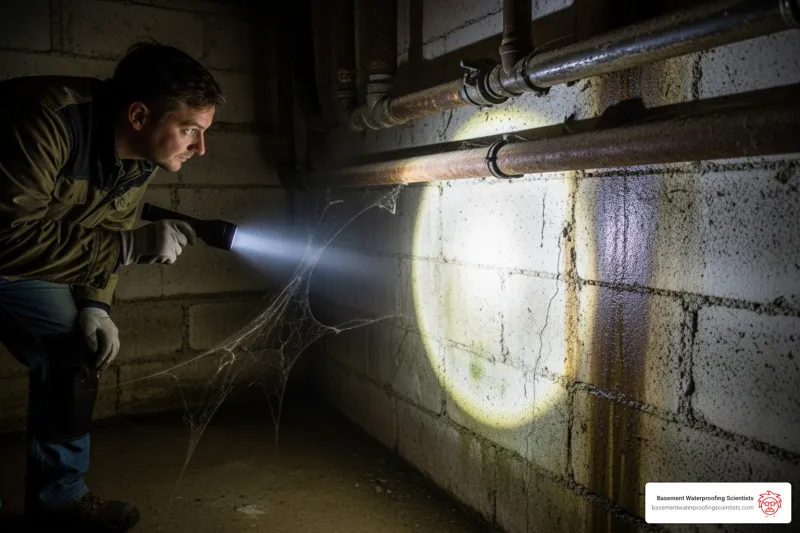
Photo: person inspecting damp basement wall with flashlight mold inspection, via images.bannerbear.com
Homeowners are taught to look for mold: dark spots on baseboards, discoloration on ceiling drywall, staining around window sills. But in more than a decade of restoration work across American homes, we've learned that the eyes are often the last organ to get the news. The nose usually knows first.
The Science Behind the Musty Smell
That characteristic damp, earthy odor people describe as "musty" isn't mold itself — it's microbial volatile organic compounds, or MVOCs. As fungi digest building materials, they release these gases as byproducts. Because MVOCs are airborne, they travel through wall cavities, under flooring, and through HVAC systems, announcing the presence of a colony long before it becomes visible.
This is why a smell can be a more sensitive detector than a walkthrough. Mold growing behind a vanity, inside a wall fed by a slow plumbing leak, or beneath a crawlspace vapor barrier may never show itself in plain view. The odor, however, does not respect drywall.
When a Smell Warrants Action
Not every odd odor is an emergency. A musty note in a rarely used basement after a wet spring is common and may resolve with dehumidification. But certain patterns should prompt a closer look:
- Persistence. The smell returns within hours of airing out the room, or greets you at the door every time you come home.
- Localization. You can notice it strongest in one room, one corner, or near a particular wall or cabinet.
- Association with history. The odor emerged after a leak, a flood, a roof problem, or a period of high humidity.
- Physical confirmation. Family members report headaches, congestion, or allergy-like symptoms that improve when they leave the house.
If one or more of these apply, the smell is data. Treat it as such.
Why We Tell Homeowners to Trust Their Noses
There's a cultural habit of apologizing for a smelly house — lighting a candle before guests arrive, running a diffuser, cracking windows before an appraiser visits. We'd argue this instinct is backwards. A persistent musty odor is your home's smoke alarm for moisture. Masking it doesn't fix the condition any more than removing the battery fixes a failing furnace.
The economics support this too. A mold problem identified by odor, before it becomes visible, is almost always a smaller and cheaper problem. By the time staining appears on paint or wallpaper, colonization has often spread across a larger surface area and may involve removal of finished materials.
The Limits of the Nose
Honesty requires the other half of the argument: smell is also an imperfect instrument. Some individuals habituate to a constant odor and stop noticing it — a phenomenon called olfactory fatigue. Longtime residents may genuinely be unable to smell a problem that guests detect immediately. And certain health conditions, medications, and smoking habits blunt odor sensitivity.
Additionally, not all dangerous mold produces a strong smell, and a strong smell doesn't always indicate dangerous mold. Odor tells you there's excess moisture and microbial activity somewhere. It cannot tell you the species, the concentration of airborne spores, or the extent of contamination.
That's where professional assessment comes in. Moisture mapping, thermal imaging, and air sampling turn a vague suspicion into a specific diagnosis — where the water is, how far it has traveled, and what needs to be removed versus dried and treated.
A Practical Rule of Thumb
Here's the standard we suggest to every homeowner we work with: if a room smells wrong, it probably is wrong. You don't need to panic, and you don't need to start tearing out drywall. But you do owe the smell an investigation. Trace it, document when it occurs, check the obvious culprits — condensation on windows, damp basement corners, the cabinet under the sink.
And if the smell persists and the source stays hidden, bring in professionals with the tools to look where you can't. Your nose did its job. The rest is about following through before a small moisture problem becomes a large remediation project.